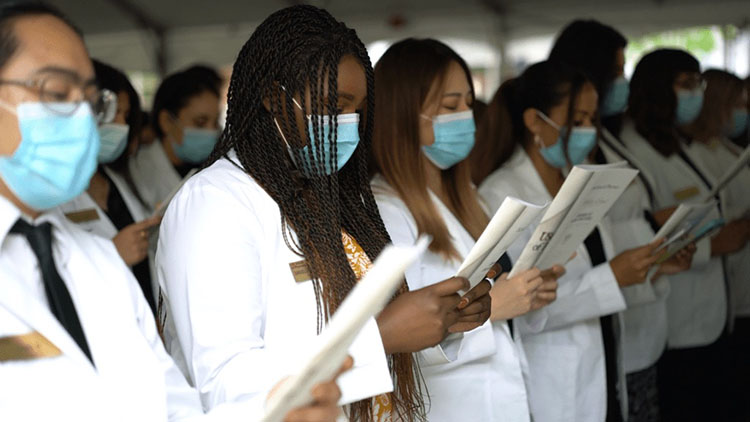
Students recite the Oath of a Pharmacist at a white coat ceremony held at Broad Lawn on the USC Health Sciences Campus.
Photo by Isaac Mora.
Founded in 1905, the USC Alfred E. Mann School of Pharmacy and Pharmaceutical Sciences is the oldest and foremost pharmacy school in Southern California. The school is a national leader known for its progressive curriculum and research excellence. Approximately 50 percent of the practicing pharmacists in Southern California are graduates of USC. The school has an average student body of 755 full-time students in the PharmD program and 417 students pursuing MS, PhD, DRSc and undergraduate degrees in pharmacology and toxicology, pharmaceutical sciences, health economics, regulatory science, healthcare decision analysis and biopharmaceutical marketing. There are 77 full-time faculty and more than 300 part-time and volunteer faculty at the school.
The school occupies state-of-the-art facilities on the USC Health Sciences Campus in metropolitan Los Angeles, adjacent to the Los Angeles General Medical Center (one of the largest teaching hospitals in the country), the USC Norris Cancer Hospital and the Keck Hospital of USC. USC Mann School students receive clinical training at these facilities and many other affiliated hospitals, healthcare clinics, skilled nursing facilities, home healthcare agencies and pharmacies in the Southern California region.
Recognized as one of the most innovative schools of pharmacy, the USC Alfred E. Mann School of Pharmacy and Pharmaceutical Sciences serves as a model for other progressive schools. In 1950, USC was the first to establish a Doctor of Pharmacy program. Additional national “firsts” that distinguish the school include: first clinical pharmacy program (1968); first PharmD/MBA dual degree program (1988); first MS and PhD programs in pharmaceutical economics and policy (1994) and first professional doctorate in regulatory science (2008).
Consistently the top private pharmacy school nationwide, the school is a member of the American Association of Colleges of Pharmacy, and the PharmD program is accredited by the Accreditation Council for Pharmacy Education, 135 S. LaSalle Street, Suite 4100, Chicago, IL 60603-4810, phone: (312) 664-3575; fax: (312) 664-4652 or (312) 664-7008.
USC Alfred E. Mann School of Pharmacy and Pharmaceutical Sciences
1985 Zonal Avenue
Los Angeles, CA 90089-9121
(323) 442-1369 (phone)
(323) 442-1681 (fax)
pharmacyschool.usc.edu
Office of Admission and Student Affairs (PharmD)
(323) 442-1466
Email: pharmadm@usc.edu
Email: pharmfa@usc.edu
pharmacyschool.usc.edu/apply/admission
Office of Graduate Affairs (PhD, MS)
(323) 442-1474
(323) 442-2258 (fax)
Email: pharmgrd@usc.edu
pharmgradprograms.usc.edu
Healthcare Decision Analysis
635 Downey Way
Verna & Peter Dauterive Hall, VPD 312
Los Angeles, CA 90089-3333
(213) 821-6478
Email: tonm@usc.edu
hcda.usc.edu
Biopharmaceutical Marketing
635 Downey Way
Verna & Peter Dauterive Hall, VPD 312
Los Angeles, CA 90089-3333
(213) 821-6478
Email: tonm@usc.edu
bpmk.usc.edu
Regulatory and Quality Sciences
1540 Alcazar St., CHP 140
Los Angeles, CA 90089
(323) 442-3102
Email: regsci@usc.edu
regulatory.usc.edu
Administration
Vassilios Papadopoulos, DPharm, PhD, DSc (hon), Dean
Steven W. Chen, PharmD, Associate Dean for Clinical Affairs
Daryl L. Davies, PhD, Associate Dean of Undergraduate Education
Kari L. Franson, PharmD, PhD, Associate Dean for Academic and Student Affairs
Irving Steinberg, PharmD, Associate Dean for Faculty Affairs
Annie Wong-Beringer, PharmD, Associate Dean for Research Affairs
Curtis T. Okamoto, PhD, Associate Dean for Graduate Education and Postdoctoral Studies
Paul Beringer, PharmD, Chair, Titus Family Department of Clinical Pharmacy
Geoffrey Joyce, PhD, Chair, Department of Pharmaceutical and Health Economics
Eunjoo Pacifici, PhD, Chair, Department of Regulatory and Quality Sciences
Clay C.C. Wang, PhD, Chair, Department of Pharmacology and Pharmaceutical Sciences
Faculty
John Stauffer Dean’s Chair in Pharmaceutical Sciences: Vassilios Papadopoulos, DPharm, PhD
William A. and Josephine A. Heeres, Endowed Chair in Community Pharmacy: Steven Chen, PharmD
University Professor and Boyd P. and Elsie D. Welin Professor in Pharmaceutical Sciences: Jean Chen Shih, PhD
Distinguished Professor of Pharmacy, Public Policy, and Economics and Leonard D. Schaeffer Director’s Chair: Dana Goldman, PhD
John A. Biles Professor in Pharmaceutical Sciences: Julio A. Camarero, PhD
Gavin Herbert Professorship in Pharmaceutical Sciences: Andrew MacKay, PhD
Charles Krown/Pharmacy Alumni Professor in Pharmaceutical Sciences: Enrique Cadenas, MD, PhD
Emeritus Professor and Dean: Timothy M. Chan, PhD
Emeritus Professors: Eric J. Lien, PhD; Bradley R. Williams, PharmD; Wei-Chiang Shen, PhD
Department of Pharmacology and Pharmaceutical Sciences
Professors of Pharmacology and Pharmaceutical Sciences: Enrique Cadenas, MD, PhD; Julio A. Camarero, PhD; Sarah F. Hamm-Alvarez, PhD; Vassilios Papadopoulos, DPharm, PhD; Jean C. Shih, PhD; Bangyan Stiles, PhD; Clay C.C. Wang, PhD
Associate Professors of Pharmacology and Pharmaceutical Sciences: Martine Culty, PhD; Roger F. Duncan, PhD; Ian S. Haworth, PhD; J. Andrew MacKay, PhD; Curtis T. Okamoto, PhD; Jennica Zaro, PhD
Assistant Professors of Pharmacology and Pharmaceutical Sciences: Zhipeng Lu, PhD; Paul Seidler, PhD; Jianming Xie, PhD; Yong (Tiger) Zhang, PhD
Lecturers: Rebecca Romero, PhD; Angel Tabancay, PhD
Titus Department of Clinical Pharmacy
Professors of Clinical Pharmacy: Melvin F. Baron, PharmD, MPA; Paul M. Beringer, PharmD; Steven Chen, PharmD; Daryl Davies, PhD; Julie A. Dopheide, PharmD; Kari L. Franson, PharmD, PhD; Stanley G. Louie, PharmD; Tien M.H. Ng, PharmD; Fred G. Weissman, PharmD, JD; Annie Wong-Beringer, PharmD
Associate Professors of Clinical Pharmacy: Melissa Durham, PharmD; Kevin L. Forrester, PharmD; Lisa W. Goldstone, PharmD; William C. Gong, PharmD; Cynthia L.L. Lieu, PharmD; Emi Minejima, PharmD; Edith Mirzaian, PharmD; Dima M. Qato, PharmD, PhD, MPH; Irving Steinberg, PharmD; Fred G. Weissman, PharmD, JD
Assistant Professors of Clinical Pharmacy: Houda Alachkar, PharmD, PhD; Carla Blieden, PharmD; Amanda Burkhardt, PhD; Michelle Chu, PharmD; David Dadiomov, PharmD; Richard Dang, PharmD; Tatyana Gurvich, PharmD; Emily Han, PharmD; Connie Kang, PharmD; Kum Ja Lee, PharmD; Serghei Mangul, PhD; Scott Mosley, PharmD; Rory O’Callaghan-Kim, PharmD; Tam Phan, PharmD; Raffi Svadjian, PharmD, MBA; Patrick Tabon, PharmD; Ying Wang, PharmD; Paul J. Wong, PharmD; Maryann Wu, EdD
Research Professor: Jing Liang, MD, PhD
Research Assistant Professor of Clinical Pharmacy: Liana Asatryan, PhD
Department of Pharmaceutical and Health Economics
Professors of Pharmaceutical and Health Economics: Dana Goldman, PhD; Joel W. Hay, PhD; Darius N. Lakdawalla, PhD
Associate Professors of Pharmaceutical and Health Economics: Geoffrey Joyce, PhD; Grant D. Lawless, MD, RPh; Jeffrey S. McCombs, PhD; John Romley, PhD; Seth Seabury, PhD; Daniel Tomaszewski, PharmD, PhD; Ken S. Wong, PharmD, MPH
Assistant Professors of Pharmaceutical and Health Economics: William Padula, PhD; Erin Trish, PhD
Research Assistant Professors of Pharmaceutical and Health Economics: Bo Zhou, PhD; Steven Fox, MD
Department of Regulatory and Quality Sciences
Professor, Department of Regulatory and Quality Sciences: Frances J. Richmond, PhD
Associate Professor, Department of Regulatory and Quality Sciences: Eunjoo Pacifici, PharmD, PhD
Assistant Professors, Department of Regulatory and Quality Sciences: Susan Bain, DRSc; Terry David Church, DRSc; C. Benson Kuo, PhD; Nancy Pire-Smerkanich, DRSc
Programs
The Mann School offers curricula leading to the Doctor of Pharmacy (PharmD) and Doctor of Regulatory Science (DRSc) degrees and graduate degrees through the Graduate School including: Doctor of Philosophy (PhD) in Health Economics; and the PhD Programs in Pharmaceutical and Translational Sciences which is a one-year umbrella program after which students select one of the following three tracks to complete their PhD degree in Pharmaceutical Sciences, Molecular Pharmacology and Toxicology, or Clinical and Experimental Therapeutics. The School also offers Master of Science (MS) in Pharmaceutical Economics and Policy; Master of Science (MS) in Pharmaceutical Sciences; Master of Science (MS) in Molecular Pharmacology and Toxicology; Master of Science (MS) in Clinical and Experimental Therapeutics; Master of Science (MS) in Healthcare Decision Analysis; Master of Science (MS) in Biopharmaceutical Marketing; Master of Science (MS) in Regulatory Science; Master of Science (MS) in Regulatory Management; Master of Science (MS) in Management of Drug Development; and Master of Science (MS) in Medical Product Quality. Eight dual degree programs are also offered, including: PharmD/PhD, PharmD/JD, PharmD/MBA, PharmD/MPH, PharmD/MS in Regulatory Science, PharmD/MS in Gerontology, PharmD/MS in Global Medicine, PharmD/MS in Healthcare Decision Analysis, and a joint degree in Pharmaceutical Economics and Policy (PhD). Graduate certificates include advanced pharmacy practice, biopharmaceutical marketing, clinical research design and management, food safety, healthcare analytics and operations, healthcare decision analysis, medical product quality, preclinical drug development, patient and product safety, and regulatory and clinical affairs.
The Mann School also offers a Bachelor of Arts (BA) and a Bachelor of Science (BS) in Pharmacology and Drug Development; a Bachelor of Arts (BA) and a Bachelor of Science (BS) in Biopharmaceutical Sciences; and minors in Biopharmaceutical Business, Science and Management of Biomedical Therapeutics, and Foundation in Regulatory Sciences.
Doctor of Pharmacy (PharmD) Program
Admission Requirements for the Doctor of Pharmacy (PharmD) Program
Applicants should possess a bachelor’s degree from an accredited college or university. A cumulative grade point average of 3.0 and a prerequisite grade point average of 3.0 or higher is strongly recommended. All students should complete the prerequisite courses that are required by the USC Alfred E. Mann School of Pharmacy and Pharmaceutical Sciences before they start the program. An interview is mandatory and required of all students prior to admission. International students are required to complete the TOEFL and may request a virtual interview.
Acceptance criteria will be assessed on a case-by-case basis. The admission committee reviews each student holistically, taken all application materials and the interview process into consideration when making an admission decision. Along with being academically prepared, having the soft skills to communicate, problem solve, build relationships and show your ability to think critically are important characteristics to demonstrate.
Tuition and Fees (Estimated)
Tuition for the PharmD at USC Mann School degree programs is charged at a flat rate (which differs from standard USC tuition). See the Tuition and Fees section for fee information. These fees are subject to change.
Doctor of Pharmacy students must pay a $1,000 non-refundable acceptance deposit that is applicable toward tuition. For deposit information in other degree programs in the USC Mann School, please consult appropriate offices.
Honor Societies
Rho Chi
Theta chapter of Rho Chi, the academic honor society in pharmacy, was established at USC in 1925. Eligibility for membership is based on high attainment in scholarship, character, personality and leadership. All candidates selected for membership must have completed three semesters of the pharmacy program (or post-qualifying exam for PhD students), and they must be approved by the dean of the USC Alfred E. Mann School of Pharmacy and Pharamceutical Sciences.
Phi Lambda Sigma
The Phi Lambda Sigma chapter was established at USC in 1988. This national pharmacy leadership society is devoted to identifying, supporting and recognizing the contribution of pharmacy students to their colleges, their classmates, their campuses, their communities and to their chosen profession.
Undergraduate Honors Program
The undergraduate honors in pharmacology and drug development (post code 1681) or biopharmaceutical sciences is awarded through successful completion of the senior capstone project. The project is a demonstration of knowledge in the student’s chosen area of interest which results in a product/project, research data, research paper, or portfolio of work, and a presentation. This experience encourages students to use a variety of skills in the areas of writing, speaking, research, and documentation, which distinguishes them as scholars and future leaders in pharmacy. Students will register in RXRS/BPSI - 493, Senior Honors Seminar I and RXRS/BPSI - 494 Senior Honors Seminar II.
Student Housing and Service Facility, Health Sciences Campus
There are no university-managed accommodations on the Health Sciences Campus. Currie Hall is privately owned, has a state-of-the-art fitness center, 24-hour academic success center, pool, wi-fi and fully furnished apartments with enhanced-privacy floor plans. For more information about Currie Hall, call (213) 784-7558 or visit the Currie Hall website.
For bookstore information, call (323) 442-2674. Students may also live in student housing on the University Park Campus, located about eight miles from the Health Sciences Campus.
Student Health Services, Health Sciences Campus
Services of the Student Health Center, covered by the mandatory student health fee, include the ambulatory care health services provided by the Student Health Center nursing staff. The Student Health Center is located in the USC Health Care Consultation Center, 1500 San Pablo Street, Suite 104, adjacent to the USC University Hospital, one block northeast of the USC Mann School. The telephone number is (323) 442-5980. In addition to the student health fee, all students must have major medical insurance coverage from the USC Student Health Plan. A student may request a waiver of the USC Student Health Plan if covered by a personal medical plan that meets criteria established by the Health Insurance Office.
Graduate Degrees
The USC Alfred E. Mann School of Pharmacy and Pharamceutical Sciences, through the Graduate School, offers curricula leading to the MS and PhD degrees in clinical and experimental therapeutics, molecular pharmacology and toxicology, pharmaceutical sciences and health economics, as well as a doctorate in Regulatory Sciences (DRSc). The Pharmaceutical and Translational Sciences (PHTS) PhD Program is a one-year umbrella program after which students select a particular track to complete their PhD in pharmaceutical sciences, molecular pharmacology and toxicology, or clinical and experimental therapeutics. The school also offers interdisciplinary MS degrees in regulatory science, in regulatory management, in the management of drug development, in medical product quality, in healthcare decision analysis and in biopharmaceutical marketing. The MS degree in pharmaceutical economics and policy is offered jointly with the USC Price School of Public Policy and the Department of Economics. In addition, the school offers dual degrees with the schools of law, business, gerontology and medicine as well as other programs. Instructions given in the Admission section of this catalogue are to be followed. An online application is required. See the Graduate Admission application page. Additional information may be obtained by calling (323) 442-1474 or sending an email to pharmgrd@usc.edu.
Admission Requirements for the Master of Science in Clinical and Experimental Therapeutics
Applicants should possess a bachelor’s degree or equivalent from an accredited college or university. Applicants with graduate or professional degrees are encouraged to apply. A minimum grade point average of 3.0 (A = 4.0) is required. Special attention is given to the grades achieved in science courses relevant to the program (e.g., chemistry, biology, biochemistry, pharmacology and mathematics). Students who have research experience and/or work experience in the pharmaceutical arena are encouraged to apply.
Acceptance criteria for those individuals will be assessed on a case-by-case basis. English proficiency is essential. Students will be selected for admission, whenever possible, after interviews with one or more members of faculty.
Admission Requirements for the Master of Science in Molecular Pharmacology and Toxicology and Master of Science in Pharmaceutical Sciences
Applicants should possess a bachelor’s or master’s degree in pharmacy, chemistry, biology or other related disciplines from an accredited college or university. A minimum grade point average of 3.0 is required. Special attention is given to the grades achieved in science courses relevant to the program (e.g., chemistry, biology, biochemistry, pharmacology and mathematics).
Applicants must have demonstrated proficiency in verbal and written English and in fundamental scientific areas such as organic and physical chemistry, biochemistry, biology, mathematics, statistics and computer science. Three letters from faculty knowledgeable about the student’s ability and capability are required. These letters should provide a thorough assessment of the student’s experience in laboratory research, ability to communicate in verbal and written English, motivation and creativity, and other qualities in the student’s academic performance.
Applications for admission are reviewed by the Pharmacology and Pharmaceutical Sciences Graduate Admissions Committee of the USC Mann School and are evaluated primarily on the basis of academic excellence.
Admission Requirements for Programs in Pharmaceutical and Translational Sciences: Doctor of Philosophy in Clinical and Experimental Therapeutics, Doctor of Philosophy in Molecular Pharmacology and Toxicology, and Doctor of Philosophy in Pharmaceutical Sciences
All prospective students will apply through the single umbrella program in Pharmaceutical and Translational Sciences and become enrolled in one of the three participating PhD programs after having successfully completed the first year’s course work and laboratory rotations. Application materials will be reviewed by a joint admission committee, with equal representation of faculty from each track, evaluating applications on the basis of academic excellence and scientific research commitment.
Applicants must have a baccalaureate degree in the natural sciences, or sufficient courses in mathematics and the life sciences. This is required to provide a strong background for studies in biomedical and biological research. Appropriate undergraduate degrees include biology, physiology, engineering, chemistry or computer science. A student currently enrolled in the PharmD program may pursue a PharmD/PhD by following the admission procedure in the Catalogue.
Applicants should have a strong record of academic achievement. A minimum grade point average of 3.0 is required and previous research experience is expected.
In addition to the application for admission, three letters of recommendation from faculty knowledgeable of the student’s ability and capability are required. These letters should provide a thorough assessment of the student’s experience in laboratory research, ability to communicate in verbal and written English, motivation, creativity and other qualities in the student’s academic performance. The student’s research and professional experience should be well described within the application and include a personal statement summarizing career objectives and research interests.
Admission Requirements for the Master of Science in Pharmaceutical Economics and Policy
Applicants for admission must have achieved a minimum 3.0 GPA in an undergraduate or professional school and adequate scores on the GRE. In addition, applicants will be required to have completed upper-division courses in statistical methods, calculus and microeconomics.
Admission Requirements for the Doctor of Philosophy in Health Economics
Candidates with a bachelor’s, master’s or PharmD degree are invited to apply. Applicants must have demonstrated proficiency in verbal and written English and aptitude in economics, mathematics, statistics and computer science. Deficiencies in economics and statistical background can be addressed through preliminary course work after admission to the program.
A minimum grade point average of at least 3.0 (A = 4.0) is required. Special attention is given to the grades achieved in economics, statistics and mathematics courses relevant to the program. A qualifying score on the GRE in verbal and quantitative areas is required. There is no set minimum score required for admission, and GRE scores are considered in conjunction with all other parts of the application.
Admission Requirements for the Master of Science in Healthcare Decision Analysis
Applicants should possess a bachelor’s degree or equivalent from an accredited college or university. Applicants with graduate or professional degrees are encouraged to apply. A minimum grade point average of 3.0 is required. The program encourages the participation of part-time students with work experience. Acceptance criteria for those individuals will be assessed on a case-by-case basis. English proficiency is essential. Additional requirements for international students are outlined by university regulations under Admission of International Students.
Admission Requirements for the Master of Science in Biopharmaceutical Marketing
Applicants should possess a bachelor’s degree or equivalent from an accredited college or university. Applicants with graduate or professional degrees are encouraged to apply. A minimum grade point average of 3.0 and qualifying scores on the GRE or GMAT examinations are required. The program encourages the participation of part-time students with work experience. Acceptance criteria for those individuals will be assessed on a case-by-case basis. English proficiency is essential. Additional requirements for international students are outlined by university regulations under Admission of International Students.
Admission Requirements for the Doctorate of Science in Regulatory Science
The program is designed for individuals with strong professional experience and demonstrated intellectual and leadership capabilities. Applicants are expected to have a GPA of 3.0 on university-level course work and ten or more years of professional experience. Admission requirements include university transcripts, a résumé or curriculum vitae, at least three letters of reference, and a one-page personal statement that outlines the background, a topic of interest for the dissertation and goals of the applicant. Students are encouraged even at this early stage to identify areas in which they are interested in conducting research. Additional requirements for international students are outlined by university regulations under Admission of International Students. (See Admission and Orientation .) Students are not required to provide GRE scores unless indicated by the program director. Applicants will be selected for admission, whenever possible, after interviews with one or more members of faculty, current student and/or alumnus of the program.
Students with an appropriate graduate or professional degree may use some previous graduate courses as transfer units toward the overall credit requirements of the Doctor of Regulatory Science program with the approval of the program director and under the policies of the university. Students who have graduated from the Master of Science program in Regulatory Science at USC are eligible to apply all of the previously taken course work toward the doctoral degree. Students with graduate degrees from outside of the Regulatory Science program are required to take a minimum of 32 units of course work and 4 units of dissertation research to complete the requirements for graduation. The course work requirements will be determined on an individual basis in consultation with the program director and student’s advisers.
Admission Requirements for the Master of Science in Regulatory Science
Applicants should possess a bachelor’s degree or equivalent from an accredited college or university. Applicants with graduate or professional degrees are encouraged to apply. A minimum grade point average of 3.0 and applicants are not required to provide GRE scores unless indicated by the program director. The program encourages the participation of part-time students with work experience.
Acceptance criteria for those individuals will be assessed on a case-by-case basis. English proficiency is essential.
Admission Requirements for the Master of Science in Management of Drug Development
Applicants should possess a bachelor’s degree or equivalent from an accredited college or university. Applicants with graduate or professional degrees are encouraged to apply. A minimum grade point average of 3.0 and applicants are not required to provide GRE scores unless indicated by the program director. The program encourages the participation of part-time students with work experience. Acceptance criteria for those individuals will be assessed on a case-by-case basis. English proficiency is essential.
Admission Requirements for the Master of Science in Medical Product Quality
Applicants should possess a bachelor’s degree or equivalent from an accredited college or university. Applicants with graduate or professional degrees are encouraged to apply. A minimum grade point average of 3.0 and applicants are not required to provide GRE scores unless indicated by the program director. The program encourages the participation of part-time students who are already working in the industry as well as students who have recently completed or are about to complete an undergraduate program.
Acceptance criteria will be assessed on a case-by-case basis. English proficiency is essential. Applicants who do not meet all the specific requirements indicated above, but who show unique potential, may be considered for admission with conditions, which may be fulfilled during the first semester of enrollment.
Admission Requirements for the Master of Science in Regulatory Management
Applicants should possess a bachelor’s degree or equivalent from an accredited college or university. Applicants should also possess a conferred doctoral degree or equivalent from an accredited college or university. A minimum grade point average of 3.0 and applicants are not required to provide GRE scores unless indicated by the program director. Acceptance criteria for those individuals will be assessed on a case-by-case basis. English proficiency is essential. The program encourages the participation of part-time students who are already working in the industry as well as students who have recently completed or are about to complete a doctoral program.
Acceptance criteria will be assessed on a case-by-case basis. English proficiency is essential. Applicants who do not meet all the specific requirements indicated above, but who show unique potential, may be considered for admission with conditions, which may be fulfilled during the first two semesters of enrollment.
Admission of International Students to Graduate Degree Programs
All requirements described in this section are also applicable to the admission of international students. In addition, special application and admission procedures are required of international students. Refer to the section on Admission of International Students in this catalogue.
Degree Requirements
These degrees are under the jurisdiction of the USC Alfred E. Mann School of Pharmacy and Pharamceutical Sciences and/or jointly with the Graduate School. Students should also refer to the Requirements for Graduation section and The Graduate School section of this catalogue for general regulations. All courses applied toward the degrees must be courses accepted by the Graduate School.
- Master of Science in Biopharmaceutical Marketing
- Master of Science in Clinical and Experimental Therapeutics
- Master of Science in Healthcare Decision Analysis
- Master of Science in Management of Drug Development
- Master of Science in Medical Product Quality
- Master of Science in Molecular Pharmacology and Toxicology
- Master of Science in Pharmaceutical Economics and Policy
- Master of Science in Pharmaceutical Sciences
- Master of Science in Regulatory Management
- Master of Science in Regulatory Science
- Doctor of Philosophy in Clinical and Experimental Therapeutics
- Doctor of Philosophy in Health Economics
- Doctor of Philosophy in Molecular Pharmacology and Toxicology
- Doctor of Philosophy in Pharmaceutical Sciences
- Doctor of Philosophy in Pharmaceutical Economics and Policy
- Doctor of Regulatory Science
- PharmD
- PharmD/Juris Doctor
- PharmD/Master of Business Administration Dual Degree Program
- PharmD/Master of Science, Gerontology
- PharmD/Master of Science, Global Medicine
- PharmD/Master of Science, Healthcare Decision Analysis
- PharmD/Master of Public Health
- PharmD/Master of Science, Regulatory Science
- PharmD/Doctor of Philosophy
Non-Degree Programs
Office of Continuing Professional Development
1985 Zonal Avenue
Los Angeles, CA 90089-9121
(323) 442-2403
FAX: (323) 442-3600
Email: pharmce@usc.edu
pharmacyschool.usc.edu/programs/ce/
Continuing Education
The USC Alfred E. Mann School of Pharmacy and Pharamceutical Sciences, Office of Continuing Professional Development, is a recognized provider of continuing pharmacy education accredited by the Accreditation Council for Pharmacy Education (ACPE) and recognized by the California State Board of Pharmacy and throughout the United States.
The school serves as a primary educational resource for pharmacists in California and as a supplementary resource for other health professionals and pharmacists, nationally and internationally.
Programs are designed to educate pharmacists about current issues in pharmaceutical care, practice management, therapeutics and other topics of professional interest. Continuing education programs are held at the USC Mann School and other locations.
For information concerning continuing education programs contact the Office of Continuing Professional Development.
Bachelor’s Degree
Minor
Joint Degree
Master’s Degree
Dual Degree
Graduate Certificate
Doctoral Degree
Biopharmaceutical Marketing
-
BPMK 500 Biopharmaceutical Marketing Management
Units: 3
Gain fundamental analytic skills and insights of medical trends directly from global payers, industry and government policy leaders covering healthcare reform, access and future therapies.
Recommended Preparation: Graduate degree in pharmacy, medicine, or related MS or PhD program
Instruction Mode: Lecture
Grading Option: Letter
-
BPMK 501 Healthcare Payers, Insurance and Coverage Policy
Units: 3
Terms Offered: Sm
Review evolution, design, forecasting future healthcare and coverage policies. Actuarial costs impact and controls on insurance premiums. Master and design successful formulary and reimbursement tactics.
Instruction Mode: Lecture
Grading Option: Letter
-
BPMK 502 Biopharmaceutical Product Development and Marketing
Units: 3
Terms Offered: Sm
Portfolio role of clinical trials, regulatory and government agencies in product development. Winning through strategy! Planning profiles for novel products R&D vs. unmet medical needs.
Instruction Mode: Lecture
Grading Option: Letter
-
BPMK 503 Biopharmaceutical Advertising and Communication
Units: 3
Terms Offered: Fa
Understand product positioning, timing and market opportunities. Key message development and communication pathways, budgets, quantitative measures for Grab and Growth! Integrated launch and market planning.
Instruction Mode: Lecture
Grading Option: Letter
-
BPMK 504 Market Access and Reimbursement Strategy
Units: 3
Profile insurance categories, controls and public demands. Aligning formulary and value measures and research. Play to Win! Quantitative assessment of market segmentation and evidence generation.
Instruction Mode: Lecture
Grading Option: Letter
-
BPMK 505 Product Health Economics and Valuation
Units: 3
Terms Offered: Fa
Applied microeconomic tools, health technology assessment, cost effectiveness and commercial utility research. Practical understanding data sets and applications of real-world outcomes research and innovative modeling.
Instruction Mode: Lecture
Grading Option: Letter
-
BPMK 506 Biopharmaceutical Product Pricing and Competition
Units: 3
Terms Offered: Sp
Design risk maps, methods and processes for competitive intelligence. War Games! Pricing tools and revenue models.
Instruction Mode: Lecture
Grading Option: Letter
-
BPMK 508 Biopharmaceutical Marketing Research and Analytics
Units: 3
Research and analytical methods for synthesizing data-driven insights informing marketing decisions of biopharmaceutical products. Apply systematic frameworks of marketing research to assess a drug’s commercial opportunities.
Registration Restriction: Not open to GSBA Business Administration students
Instruction Mode: Lecture
Grading Option: Letter
-
BPMK 509 Seminars in Biopharmaceutical Marketing
Units: 1
Max Units: 03
Weekly seminar and literature series to review and discuss policy of biopharmaceutical and healthcare access issues. Student-led discussions, expert guest speakers, group projects, critical thinking.
Registration Restriction: Not open to GSBA Business Administration students
Instruction Mode: Lecture
Grading Option: Letter
-
BPMK 510 Capstone I: Biopharmaceutical Management Project
Units: 3
Terms Offered: Fa
Program directed basic research and topics to develop student core skills surrounding research design, execution, planning, presentation and defense, consistent with BP industry standards.
Instruction Mode: Lecture
Grading Option: Letter
-
BPMK 511 Capstone II: Biopharmaceutical Management Project
Units: 3
Terms Offered: Sp
Student directed advanced research and topics to develop student individual skills surrounding research design, execution, planning, presentation and defense, consistent with BP industry standards.
Instruction Mode: Lecture
Grading Option: Letter
-
BPMK 599 Special Topics
Units: 1, 2, 3, 4, 5, 6, 7, 8
Max Units: 08
Special Topics in Biopharmaceutical Marketing.
Instruction Mode: Lecture
Grading Option: Letter
Biopharmaceutical Sciences
-
BPSI 402 Biopharmaceutics I
Units: 4
Comprehensive overview of pharmaceutical sciences. Interdisciplinary areas of study that deal with the design, action, delivery, disposition and patient acceptance of drugs.
Instruction Mode: Lecture
Grading Option: Letter
-
BPSI 403 Biopharmaceutics II
Units: 4
Comprehensive overview of early drug discovery and medicinal product development; in vitro and in vivo assays simulations/modeling, biopharmaceutical classification system, drug delivery science and technology.
Instruction Mode: Lecture
Grading Option: Letter
-
BPSI 405 Organ Systems Physiology, Drug Delivery and Drug Action
Units: 4
Principles of cellular and organ physiology systems. Interplay between the physiology of organ systems, drug delivery and drug action.
Duplicates Credit in former RXRS 420
Instruction Mode: Lecture
Grading Option: Letter
-
BPSI 406 Drug Safety Pharmacology and Toxicology
Units: 4
Toxicology and safety pharmacology principles that guide the clinical development of safe and efficacious drugs and biologics.
Instruction Mode: Lecture
Grading Option: Letter
-
BPSI 407 Pharmaceutical and Health Economics
Units: 4
Application of economics principles to pharmaceutical and health care issues; prescription drug pricing, access and innovation; topics related to pharmaceutical policy.
Duplicates Credit in former RXRS 415
Instruction Mode: Lecture
Grading Option: Letter
-
BPSI 408 Biologics and Vaccines
Units: 4
How biologics and vaccines are researched, designed and used to treat and prevent diseases; regulatory and ethical issues surrounding these therapeutics.
Instruction Mode: Lecture
Grading Option: Letter
-
BPSI 410 Biopharmaceutical Product Development and Brand Planning
Units: 4
Introduces critical financial decisions and development milestones in biopharmaceutical drug product development and commercialization. Learn to align business strategies with decisions supporting a product lifecycle.
Instruction Mode: Lecture
Grading Option: Letter
-
BPSI 411 Biopharmaceutical Marketing Analysis and Strategy
Units: 4
Introduces marketing analysis and strategy for biopharmaceutical drugs. Learn to conduct analysis to develop integrated marketing strategies and to execute on marketing and promotion plans.
Instruction Mode: Lecture
Grading Option: Letter
-
BPSI 412 Targeted and Precision Medicines
Units: 4
Precision medicine utilizing data from basic science, clinical, personal, environmental and population settings; understanding biological processes and disease mechanisms; develop precise diagnostics, therapeutics and prevention.
Instruction Mode: Lecture
Grading Option: Letter
-
BPSI 413 Rigor, Resources and Reproducibility
Units: 2
Medical product business planning in public-private partnerships to enhance scientific rigor, expand resource sharing and manage corporate responsibility in developing new products.
Instruction Mode: Lecture
Grading Option: Letter
-
BPSI 414 Pharmacoethics
Units: 2
Ethics as a challenge in the pharmaceuticals industry. Organizational ethics and bioethics related to research, development and marketing across the public and healthcare professional groups.
Instruction Mode: Lecture
Grading Option: Letter
-
BPSI 415 Science Talk
Units: 2
Students will learn to present science to others using techniques of storytelling, informative, commemorative, persuasive speeches, interviews and scientific presentations; strategies to reduce speaker apprehension.
Instruction Mode: Lecture
Grading Option: Letter
-
BPSI 490x Directed Research
Units: 1, 2, 3, 4, 5, 6, 7, 8
Max Units: 12
Individual research, reading, writing and project development.
Credit Restriction: Not available for graduate degree credit
Instruction Mode: Lecture
Grading Option: Letter
-
BPSI 493 Senior Honors Seminar I
Units: 2
Exciting and challenging opportunity to marshal and deploy research, analysis, interpretation and writing skills learned in their major.
Registration Restriction: Open to juniors and seniors in the BioPharmaceutical Sciences major
Instruction Mode: Lecture
Grading Option: Letter
-
BPSI 494 Senior Honors Seminar II
Units: 2
An independent study course for students undertaking the research and writing of an Honors thesis.
Prerequisite: BPSI 493
Registration Restriction: Open only to juniors and seniors in the BioPharmaceutical Sciences major
Instruction Mode: Lecture
Grading Option: Letter
Clinical and Experimental Therapeutics
-
CXPT 501 Biomedical Data Sciences
Units: 4
Terms Offered: Fa
Basics concept of code-based biomedical data analysis and visualization. Introduction to rigorous and reproducible analytical tools, including Python-based interactive notebooks. Appropriate use of statistical analysis.
Instruction Mode: Lecture
Grading Option: Letter
-
CXPT 590 Directed Research
Units: 1, 2, 3, 4, 5, 6, 7, 8, 9, 10, 11, 12
Terms Offered: FaSpSm
Research leading to the master’s degree. Maximum units which may be applied to the degree to be determined by the department.
Instruction Mode: Lecture
Grading Option: Credit/No Credit
-
CXPT 594a Master’s Thesis
Units: 2
Terms Offered: FaSpSm
Credit on acceptance of Master’s thesis.
Recommended Preparation: Completion of all required course work for MS degree
Instruction Mode: Lecture
Grading Option: In Progress/Credit/No Credit
-
CXPT 594b Master’s Thesis
Units: 2
Terms Offered: FaSpSm
Credit on acceptance of master’s thesis.
Prerequisite: CXPT 594a
Instruction Mode: Lecture
Grading Option: In Progress/Credit/No Credit
-
CXPT 594z Master’s Thesis
Units: 0
Terms Offered: FaSpSm
Credit on acceptance of Masters thesis.
Prerequisite: CXPT 594b
Instruction Mode: Lecture
Grading Option: In Progress/Credit/No Credit
-
CXPT 596 Internship for Curricular Practical Training
Units: 1, 2, 3
Max Units: 03
Terms Offered: FaSpSm
Part-time or full-time, practical work experience in the student’s field of study. The internship must be located at an off-campus facility. Students are individually supervised by faculty. May not be taken until the student has completed at least one semester of enrollment in the graduate program with a cumulative 3.0 GPA.
Registration Restriction: Open only to graduate students
Instruction Mode: Lecture
Grading Option: Credit/No Credit
-
CXPT 599 Special Topics
Units: 1, 2, 3, 4, 5, 6, 7, 8
Max Units: 08
Selected topics in Clinical and Experimental Therapeutics.
Instruction Mode: Lecture
Grading Option: Letter
-
CXPT 609 Preclinical Experimental Drug Therapeutic Development
Units: 4
Terms Offered: Sp
Evolution of a chemical entity as it is transformed into a drug candidate. Open only to students in clinical and experimental therapeutics and management of drug development.
Registration Restriction: Open only to students in Clinical and Experimental Therapeutics and Management of Drug Development.
Instruction Mode: Lecture
Grading Option: Letter
-
CXPT 610 Experimental and Clinical Drug Metabolism and Transport
Units: 4
Terms Offered: Fa
Focus on the absorption, distribution, metabolism and elimination (ADME) of new chemical entities, with particular focus on biotransformation process.
Instruction Mode: Lecture, Quiz
Grading Option: Letter
-
CXPT 664 Clinical Problem Solving
Units: 3
Terms Offered: FaSp
Experiential/case base course for graduate students who are enrolled in the Clinical Experimental Therapeutics (CXPT) MS or PHTS-PhD programs.
Duplicates Credit in former PHRD 664
Instruction Mode: Lecture, Discussion
Grading Option: Letter
-
CXPT 790 Research
Units: 1
Max Units: 12
Terms Offered: FaSpSm
Research-based course for students enrolled in the CXPT PhD program who are preparing for their written and oral qualifying examination.
Instruction Mode: Lecture
Grading Option: Credit/No Credit
-
CXPT 794a Doctoral Dissertation
Units: 2
Terms Offered: FaSpSm
Independent research course for students enrolled in the CXPT PhD program who have passed their written and oral qualifying examination and advanced to PhD candidacy.
Instruction Mode: Lecture
Grading Option: In Progress/Credit/No Credit
-
CXPT 794b Doctoral Dissertation
Units: 2
Terms Offered: FaSpSm
Independent research course for students enrolled in the CXPT PhD program who have passed their written and oral qualifying examination and advanced to PhD candidacy.
Prerequisite: CXPT 794a
Instruction Mode: Lecture
Grading Option: In Progress/Credit/No Credit
-
CXPT 794c Doctoral Dissertation
Units: 2
Terms Offered: FaSpSm
Independent research course for students enrolled in the CXPT PhD program who have passed their written and oral qualifying examination and advanced to PhD candidacy.
Prerequisite: CXPT 794b
Instruction Mode: Lecture
Grading Option: In Progress/Credit/No Credit
-
CXPT 794d Doctoral Dissertation
Units: 2
Terms Offered: FaSpSm
Independent research course for students enrolled in the CXPT PhD program who have passed their written and oral qualifying examination and advanced to PhD candidacy.
Prerequisite: CXPT 794c
Instruction Mode: Lecture
Grading Option: In Progress/Credit/No Credit
-
CXPT 794z Doctoral Dissertation
Units: 0
Terms Offered: FaSpSm
Independent research course for students enrolled in the CXPT PhD program who have passed their written and oral qualifying examination and advanced to PhD candidacy.
Prerequisite: CXPT 794d
Instruction Mode: Lecture
Grading Option: In Progress/Credit/No Credit
Health Care Decision Analysis
-
HCDA 501 Fundamentals of Healthcare Insurance Design
Units: 3
Terms Offered: Sm
Introduction to insurance payer types, functions, actuarial pricing methods, network design and business operations impacting the provision of health benefits and reimbursement for medical products and services.
Instruction Mode: Lecture
Grading Option: Letter
-
HCDA 502 Comparative International Healthcare Systems
Units: 3
Terms Offered: Sp
Health coverage and funding across seven industrial countries, with examination of variances and similarities in stated policy and outcomes by region and population mix.
Instruction Mode: Lecture
Grading Option: Letter
-
HCDA 503 Competitive Healthcare Intelligence
Units: 3
Terms Offered: Fa
Analysis and techniques to evaluate marketplace opportunities with product launching, positioning strategies, intelligence gathering and decision-making.
Instruction Mode: Lecture
Grading Option: Letter
-
HCDA 506 Foundations of Insurance and Global Access
Units: 3
Terms Offered: Fa
Basic overview focused on the coverage, payment, reimbursement and access to healthcare and pharmaceuticals across a global landscape including the US, EU, and the big five countries of Asia-Pacific.
Instruction Mode: Lecture
Grading Option: Letter
-
HCDA 507 Foundations of Product Development and Commercialization
Units: 3
Terms Offered: Sp
Basic introduction focused on the pathways and principles for managing new health technology discovery, funding, development, Food and Drug Administration (FDA) approval, and commercial market launch.
Instruction Mode: Lecture
Grading Option: Letter
-
HCDA 510 Business Implications of Healthcare Policy
Units: 3
Terms Offered: Sm
Overview of healthcare policies that impact payers, employers, healthcare industry, state and federal agencies and consumers; individual and mandated benefits, medical loss ratio, health care exchanges and impact of comparative effectiveness review.
Instruction Mode: Lecture
Grading Option: Letter
-
HCDA 515 Healthcare Decision Analysis and Modeling
Units: 3
Terms Offered: Sp
Quantitative methods of evaluating business, policy, pharmaceuticals, medical care resource allocations. Budget Impact Models, Decision Trees, Sensitivity Analysis tradeoffs between treatment strategies, interventions, risks, outcomes.
Instruction Mode: Lecture
Grading Option: Letter
-
HCDA 520 Health Economic and Outcomes Methodology
Units: 3
Comprehensive review of core biostatistics principles and applications through practical problem solving approach and case studies. Statistical methods, data validation and outcomes research, clinical trials.
Instruction Mode: Lecture
Grading Option: Letter
-
HCDA 525 Healthcare Literature Analysis and Applications
Units: 3
Review and critique of health economics, P&T and outcomes literature. Core biostatical measures used to deconstruct and evaluate published research through case studies.
Recommended Preparation: HCDA 520 .
Instruction Mode: Lecture
Grading Option: Letter
-
HCDA 530 Total Product Development: Benchtop to Launch
Units: 3
Systematic review from discovery to market assessment, bio-targeting through clinical trial design. Profile past and current launch strategies, pharmacovigilance, regulatory and filing requirements.
Instruction Mode: Lecture
Grading Option: Letter
-
HCDA 540 Executive Leadership and Healthcare Marketing
Units: 3
Critical principles of leadership, communication, best practice marketing presentations, project management techniques, business innovations and strategy. Use of case studies, team projects, real world examples.
-
HCDA 550 Healthcare Innovation: Creativity to Value
Units: 3
Systematically review creativity and innovation techniques across healthcare industry, examine breakthrough genomic and biopharmaceutical processes and thinking, evaluate novel therapeutic and economic measures transforming outcomes.
Instruction Mode: Lecture
Grading Option: Letter
-
HCDA 553 Advanced Pricing Strategies
Units: 3
Positioning products in global markets; market share targets, payer value, life cycle and launch techniques, tools for formulary positioning and reimbursement.
Instruction Mode: Lecture
Grading Option: Letter
-
HCDA 560 Managing Effective Partnerships and Mergers
Units: 3
M&A and partnering in the health care industry; law, due diligence, contracts, research alliances, structured agreements, global partners, and tactical business strategies.
Instruction Mode: Lecture
Grading Option: Letter
-
HCDA 570 Asia Pacific: Access, Delivery and Reimbursement
Units: 3
In-depth review China, India, Japan, Korea, Taiwan. Analyzing regional pharmaceutical industry, research, manufacturing, partnerships, licensing, trials. Compare insurance, pricing, access, reimbursement for drugs, healthcare services.
Instruction Mode: Lecture
Grading Option: Letter
-
HCDA 572 Introduction to Healthcare Data Analytics
Units: 3
Terms Offered: FaSp
Learn methods for working with large health data sets, including developing an analytic plan and selecting an appropriate data source, as well as practical skills needed to manage and use large health data sets to accomplish an analytic goal.
Recommended Preparation: Previous experience in data analysis or conducting scientific research. Knowledge of basic research techniques used within various healthcare disciplines
Instruction Mode: Lecture
Grading Option: Letter
-
HCDA 580 Seminars in Healthcare Decision Analysis
Units: 1, 2, 3
Max Units: 03
Terms Offered: FaSpSm
Weekly seminar and literature series, review and discuss policy, biopharmaceuticals, insurance, global healthcare access issues. Student lead discussions, expert guest speakers, group projects, critical thinking.
Instruction Mode: Lecture
Grading Option: Letter
-
HCDA 589 Healthcare Consulting Enterprise Team Project
Units: 3
Max Units: 06
Terms Offered: FaSp
Team projects solving real business problems in the healthcare industry by working directly with an existing company under the supervision of a faculty member.
Prerequisite: HCDA 506 and HCDA 507
Recommended Preparation: Undergraduate or professional degree in pharmacy, medical or sciences, engineering, business and/or equivalent experience in the healthcare industry
Instruction Mode: Lecture
Grading Option: Letter
-
HCDA 590 Directed Research
Units: 1, 2, 3, 4, 5, 6, 7, 8, 9, 10, 11, 12
Max Units: 12.0
Terms Offered: FaSpSm
Research leading to the master’s degree. Maximum units which may be applied to the degree to be determined by the department.
Instruction Mode: Lecture
Grading Option: Credit/No Credit
-
HCDA 596 Internship for Curricular Practical Training
Units: 1, 2, 3
Max Units: 03
Terms Offered: FaSpSm
Part-time or full-time, practical work experience in the student’s field of study. The internship must be located at an off-campus facility. Students are individually supervised by faculty. May not be taken until the student has completed at least one full academic year of enrollment in the graduate program with a cumulative 3.0 GPA.
Registration Restriction: Open only to graduate students
Instruction Mode: Lecture
Grading Option: Credit/No Credit
-
HCDA 599 Special Topics
Units: 2, 3, 4
Max Units: 8.0
Terms Offered: FaSpSm
Special topics in Healthcare Decision Analysis.
Instruction Mode: Lecture
Grading Option: Letter
Molecular Pharmacology and Toxicology
-
MPTX 500 Molecular Pharmacology and Toxicology I
Units: 4
Terms Offered: Fa
This is the first part of a two-semester introductory and survey course for the molecular pharmacology and toxicology degree program.
Prerequisite: knowledge of biochemistry.
Instruction Mode: Lecture
Grading Option: Letter
-
MPTX 501 Molecular Pharmacology and Toxicology II
Units: 4
Terms Offered: Sp
The second part of the two-semester course covers the general aspects of molecular pharmacology and toxicology on the basis of biochemical, molecular, biological and environmental approaches.
Prerequisite: MPTX 500 .
Instruction Mode: Lecture
Grading Option: Letter
-
MPTX 502 Pharmacology
Units: 4
Terms Offered: Fa
Fundamentals of pharmacology in the context of the rapidly developing knowledge of related disciplines.
Instruction Mode: Lecture
Grading Option: Letter
-
MPTX 510 Topics in Pharmacology: the Other Side of Drugs
Units: 2, 3
Terms Offered: Fa
Nexus of pharmacology and toxicology; therapeutic use and toxicology of common drugs; and prescribing these drugs in clinical practice.
Instruction Mode: Lecture
Grading Option: Letter
Crosslisted as PHRD 678 -
MPTX 511 Introduction to Medical Product Regulation
Units: 3
Terms Offered: Sm
Introduction to regulatory environments surrounding medical product development, manufacturing and marketing; operation of federal, state and international regulatory bodies.
Recommended Preparation: undergraduate degree in pharmacy, medicine or independent health sciences, engineering or equivalent mix of post-secondary training and industry experience.
Instruction Mode: Lecture
Grading Option: Letter
-
MPTX 512 Regulation of Pharmaceutical and Biological Products
Units: 3
Terms Offered: Sm
Ensuring safety and effectiveness of new drugs and biologics; marketing and monitoring approved pharmaceutical/biological products; management of genetically engineered products.
Recommended Preparation: undergraduate degree in pharmacy, medicine or independent health sciences, engineering or equivalent mix of post-secondary training and industry experience.
Instruction Mode: Lecture
Grading Option: Letter
-
MPTX 513 Regulation of Medical Devices and Diagnostics
Units: 3
Terms Offered: Sm
Development and testing of new medical products according to U.S. and international regulatory requirements.
Recommended Preparation: undergraduate degree in pharmacy, medicine or independent health sciences, engineering or equivalent mix of post-secondary training and industry experience.
Instruction Mode: Lecture
Grading Option: Letter
-
MPTX 514 Regulation of Food and Dietary Supplements
Units: 3
Terms Offered: Sm
Regulation and testing of foods, food additives and dietary supplements in the U.S. and abroad.
Recommended Preparation: undergraduate degree in pharmacy, medicine or independent health sciences, engineering or equivalent mix of post-secondary training and industry experience.
Instruction Mode: Lecture
Grading Option: Letter
-
MPTX 515 Quality Systems and Standards
Units: 3
Terms Offered: Sm
Principles of quality assurance and quality control for medical-product development and manufacture.
Recommended Preparation: undergraduate degree in pharmacy, medicine or independent health sciences, engineering or equivalent mix of post-secondary training and industry experience.
Instruction Mode: Lecture
Grading Option: Letter
-
MPTX 516 Medical Products and the Law
Units: 3
Terms Offered: Fa
Legal issues affecting intellectual property, medical product development, marketing and safety, taught through case studies and lectures.
Recommended Preparation: undergraduate degree in pharmacy, medicine or independent health sciences, engineering or equivalent mix of post-secondary training and industry experience.
Instruction Mode: Lecture
Grading Option: Letter
-
MPTX 517 Structure and Management of Clinical Trials
Units: 4
Terms Offered: FaSpSm
Development and execution of clinical trials: bioethical principles, good clinical practices, project management and documentation.
Instruction Mode: Lecture
Grading Option: Letter
-
MPTX 518 Writing Regulatory Drug Submissions
Units: 3
Terms Offered: Sp
Developing form and content for investigational drug applications, new drug applications, biologic licensing applications to FDA; common technical documents; considerations of writing style.
Instruction Mode: Lecture
Grading Option: Letter
-
MPTX 519 Global Regulation of Medical Products
Units: 3
Terms Offered: Fa
Regulatory requirements governing medical products in European Union, Asia and other global markets.
Instruction Mode: Lecture
Grading Option: Letter
-
MPTX 520 Toxicology and the Media
Units: 2, 3
Terms Offered: Sp
Increase knowledge of toxicology relevance in everyday life through the reading, critical analysis and discussion of articles about current toxicological issues in the media.
Instruction Mode: Lecture
Grading Option: Letter
Crosslisted as PHRD 679 -
MPTX 522 Introduction to Clinical Trial Design and Statistics
Units: 3
Clinical designs and statistics commonly used to test medical products in general populations and special patient groups.
Instruction Mode: Lecture
Grading Option: Letter
-
MPTX 524 Introduction to Food Science and Technology
Units: 3
Terms Offered: Sm
Discusses the basic and applied concepts of food science and food safety, and demonstrates the principles of food chemistry, sensory evaluation, and product development.
Recommended Preparation: undergraduate degree in biological sciences or related disciplines.
Instruction Mode: Lecture
Grading Option: Letter
-
MPTX 526 Chemistry Manufacturing and Controls
Units: 3
Terms Offered: Fa
Provides a firm foundation in the domestic and international CMC process, from concept to commercialization of new active pharmaceutical ingredients and products.
Recommended Preparation: undergraduate degree in pharmacy, medicine or independent health science, engineering or equivalent.
Instruction Mode: Lecture
Grading Option: Letter
-
MPTX 531 Cell Biology
Units: 4
Terms Offered: Fa
(Enroll in INTD 531 )
-
MPTX 561 Molecular Biology
Units: 4
Terms Offered: Fa
(Enroll in INTD 561 )
-
MPTX 571 Biochemistry
Units: 4
Terms Offered: Sp
(Enroll in INTD 571 )
-
MPTX 572 Medical Physiology I
Units: 4
Terms Offered: Fa
(Enroll in INTD 572 )
-
MPTX 573 Medical Physiology II
Units: 4
Terms Offered: Sp
(Enroll in INTD 573 )
-
MPTX 590 Directed Research
Units: 1, 2, 3, 4, 5, 6, 7, 8, 9, 10, 11, 12
Terms Offered: FaSpSm
Research leading to the master’s degree. Maximum units which may be applied to the degree to be determined by the department.
Instruction Mode: Lecture
Grading Option: Credit/No Credit
-
MPTX 594a Master’s Thesis
Units: 2
Terms Offered: FaSpSm
Credit on acceptance of thesis.
Instruction Mode: Lecture
Grading Option: In-progress to Credit/No Credit
-
MPTX 594b Master’s Thesis
Units: 2
Terms Offered: FaSpSm
Credit on acceptance of thesis.
Instruction Mode: Lecture
Grading Option: In-progress to Credit/No Credit
-
MPTX 594z Master’s Thesis
Units: 0
Terms Offered: FaSpSm
Credit on acceptance of thesis.
Instruction Mode: Lecture
Grading Option: In-progress to Credit/No Credit
-
MPTX 596 Internship for Curricular Practical Training
Units: 1, 2, 3
Max Units: 03
Terms Offered: FaSpSm
Part-time or full-time, practical work experience in the student’s field of study. The internship must be located at an off-campus facility. Students are individually supervised by faculty. May not be taken until the student has completed at least one semester of enrollment in the graduate program with a cumulative 3.0 GPA.
Registration Restriction: Open only to graduate students
Instruction Mode: Lecture
Grading Option: Credit/No Credit
-
MPTX 599 Special Topics
Units: 2, 3, 4
Max Units: 8.0
Special topics in Molecular Pharmacology and Toxicology.
Instruction Mode: Lecture
Grading Option: Letter
-
MPTX 602 Science, Research and Ethics
Units: 2
Terms Offered: Fa
A discussion of the unique technological and philosophical issues that challenge modern scientists and a discernment of ethical responses to those challenges.
Instruction Mode: Lecture
Grading Option: Letter
-
MPTX 630 Directed Field-Research Project
Units: 6
Terms Offered: FaSpSm
Research/policy analysis conducted under preceptor supervision in an industrial or governmental setting.
Registration Restriction: Open to students who have completed the majority of course credits in the Regulatory Science program.
Instruction Mode: Lecture
Grading Option: Credit/No Credit
-
MPTX 700 Seminar in Molecular Pharmacology and Toxicology
Units: 1
Max Units: 8.0
Terms Offered: FaSp
Contemporary advances in molecular pharmacology and toxicology research. Registration required during each year of residency.
Instruction Mode: Lecture
Grading Option: Letter
-
MPTX 790 Research
Units: 1, 2, 3, 4, 5, 6, 7, 8, 9, 10, 11, 12
Terms Offered: FaSpSm
Research leading to the doctorate. Maximum units which may be applied to the degree to be determined by the department.
Instruction Mode: Lecture
Grading Option: Credit/No Credit
-
MPTX 794a Doctoral Dissertation
Units: 2
Terms Offered: FaSpSm
Credit on acceptance of dissertation.
Instruction Mode: Lecture
Grading Option: In-progress to Credit/No Credit
-
MPTX 794b Doctoral Dissertation
Units: 2
Terms Offered: FaSpSm
Credit on acceptance of dissertation.
Instruction Mode: Lecture
Grading Option: In-progress to Credit/No Credit
-
MPTX 794c Doctoral Dissertation
Units: 2
Terms Offered: FaSpSm
Credit on acceptance of dissertation.
Instruction Mode: Lecture
Grading Option: In-progress to Credit/No Credit
-
MPTX 794d Doctoral Dissertation
Units: 2
Terms Offered: FaSpSm
Credit on acceptance of dissertation.
Instruction Mode: Lecture
Grading Option: In-progress to Credit/No Credit
Page:
1
|
2
|
3
|
4
You must be logged in to post a comment.